


Photon Avalanche
Among different anti-Stokes emissions, where emitted photons have larger energy than the absorbed photons, photon avalanche (PA) phenomenon is unique. It originates from a very non-linear increase of luminescence intensity in response to minute rise of excitation intensity above some threshold pump power density. PA was first observed in the year 1979 in Pr3+ doped LaCl3 quantum counters. Since then, PA became an interesting topic and was investigated in various bulk materials doped with lanthanide ions such as Tm3+, Pr3+, Ho3+ or Er3+. It became a challenge to demonstrate the PA at a smaller scale materials, and only recently PA at nanoscale was achieved for Tm3+ doped NaYF4 and LiYF4 nanocrystals.
Understanding photon avalanche process
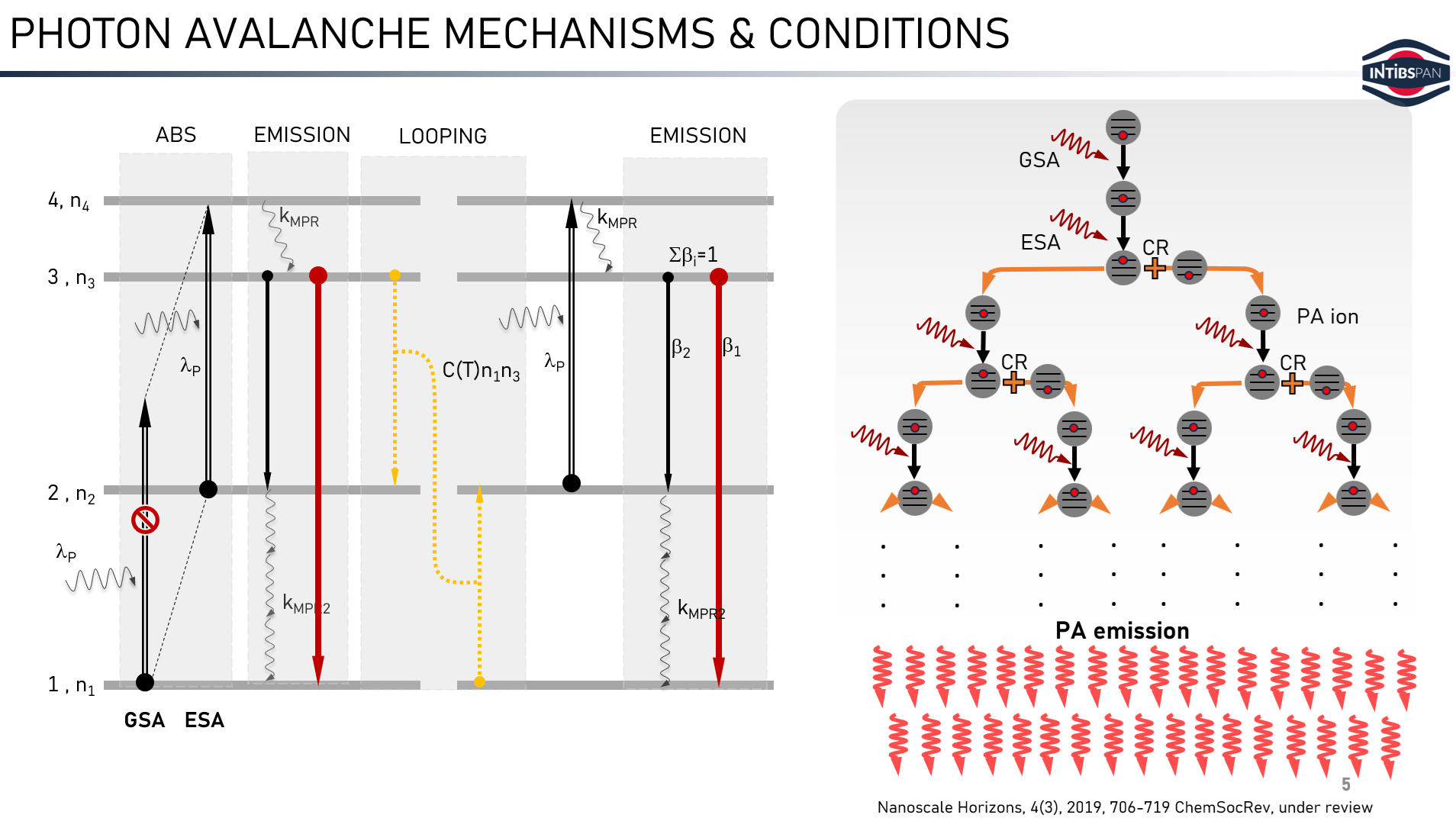
In order to comprehend the origin of unusual PA luminescent properties, it is necessary to describe the underlying energy transfer processes:
1. Ground state absorption (GSA) – Weak sideband absorption is necessary as the first step to promote at least single lanthanide ions to the first excited level. The population of these intermediate level is required to enable the energy looping and ultimately significantly increase luminescence intensity.
2. Excited state absorption (ESA) – The excited electrons can further resonantly absorb the light and futher advance to higher energy levels. Due to energy mismatch, GSA is much less probable than the resonant ESA (typically the absorption cross-section ESA to GSA ratio should go above 104). Due to ESA, higher energy levels are reached.
3. Cross relaxation (CR) – CR is non-radiative energy transfer process, in which excited electron from higher excited state non-radiatively transfers part of it’s energy to neighboring lanthanide ions, whose electron stay in ground state. The yield of such energy transfer are two electrons that are both in some intermediate excited state. Consequently, the energy of photons being absorbed by PA material are not re-emitted but cumulate in the excited levels of rising number of lanthanides.
4. Energy looping (EL) – It is basically a cycle of ESA and CR processes, that lasts as long as there are electrons that still can be excited. It’s final step that leads to saturation of the system with excited electrons. If there are no more electrons to excite the PA threshold has been reached and strong emission occurs which is accompanied by electrons returning to the ground state. These electrons can de novo participate in energy looping under continuous wave excitation.
The photon avalanche is a positive looping system with high gain, that lead to highly non-linear relationship between input (pump photon flux) and output (photon avalanche emission). Originally only two possible applications gained attention, namely medium infrared photon counters and upconversion lasers. Currently, having nanoscale photon avalanche materials available, some new types of possible applications can be predicated or have been already demonstrated.
Applications:
PA for superresolution imaging In order to overcome limit of diffraction, multiple techniques were designed, that allows to visualize nanoscale objects beyond limit of light diffraction. However many of those techniques are often riddled with various issues, that hinder widespread application, such as photobleaching of organic dye labels or necessity of employment of complex & quite often particularly expensive equipment. To address those issues it was proposed to use PA lanthanide-doped nanoparticle labels, that are resistant to photobleaching and can significantly simplify necessary optical setup (e. g. eliminating the need for second “depletion” beam spatial overlap or temporal synchronization in STED).
Because PA is a looping system, the utilization of chemical (acceptor molecules) or physical (temperature or pressure) factors that disrupts PA gain, provides efficient way to detect biological / physical processes at the molecular scale. For example, Förster Resonance Energy Transfer (FRET) that relies on robust energy transfer between donor and acceptor, it is of substance to ensure that those agents do not photobleach nor display any unwanted spectral characteristics. Once again, the employment of PA capable lanthanide-based nanoparticles proved to be a significant step forward in terms of improving the resolution & sensitivity, limiting the toxicity as well as eliminating the background, owing to efficient anti-Stokes emission, which can’t be realized in organic dyes nor quantum dots. Underlined features should enable fairly safe and effective way of sensing in biological systems of such species as proteins, DNA or antigen-antibody interaction with in vitro & in vivo regime.
Recently we have also proposed and demonstrated PA materials to enable all-optical data processing using reservoir computing approach. Reservoir computing is a framework for computation derived from recurrent neural network theory. It involves a "reservoir," which is the internal structure of the computer, made up of individual, non-linear units capable of storing information. The reservoir is treated as a "black box," and a simple readout mechanism is trained to read the state of the reservoir. One key benefit of this framework is that training is performed only at the readout stage, as the reservoir dynamics are fixed. Reservoir computing is well-suited for learning dynamical systems and requires very small training data sets, using linear optimization and minimal computing resources [1, 2, 3]. The major demonstration of our research article was the digit classification and pulses coincidence detection in PA nanomaterials. The study shows that PA emission intensity exhibits a remarkable nonlinear response to photostimulation, as well as critical slowing down of the luminescence risetimes at PA threshold. The research also highlights the sensitivity of PA emission intensity to various external parameters such as photoexcitation modulation signal frequency, optical excitation intensity, and pump pulse width. This in situ susceptibility of the response to external parameters is known as plasticity, which is a major source of adaptations to sensory inputs and transient changes in behavioral states. The findings suggest the potential use of time-resolved PA emission as a coincidence detection mechanism and for neuromorphic data processing.
Photon avalanche nanocrystals can also serve as temperature sensors. Photon avalanche emission relies on a feedback loop between excited-state absorption (ESA) and cross-relaxation (CR) processes – a loop that, at sufficient pump power, leads to a sharp amplification of emission. Temperature, however, disrupts this loop by accelerating non-radiative energy losses through crystal lattice vibrations (phonons). A theoretical framework describing this phenomenon was proposed by Szalkowski et al. [4], who extended the rate-equation model for NaYF4:Tm3+ nanocrystals to include temperature-dependent terms. Multiphonon relaxation (MPR) plays a central role: even a modest rise in temperature exponentially accelerates this process, depleting the intermediate-level populations required to sustain the energy feedback loop. As a result, the photon avalanche threshold – the minimum laser power density at which PA emission appears – shifts toward higher values as temperature increases. In 2023, Korczak et al. [5] experimentally confirmed this relationship by studying colloidal NaYF4 nanocrystals co-doped with Yb3+ and Pr3+ ions in a core–shell architecture, across a temperature range spanning from −175°C to +175°C. On one hand, as temperature rises, the total emission intensity decreases and the photon avalanche threshold increases – in line with expectations from enhanced phonon-induced losses. On the other hand, the nonlinearity and gain of the PA response simultaneously increase. This apparent paradox is explained by the thermal activation of specific cross-relaxation pathways that double the population of the 1G4 level of Pr3+ ions. The reinforced CR tightens the feedback loop, making the characteristic luminescence jump more pronounced. Temperature thus plays a dual role: it suppresses emission and raises the threshold, while at the same time sharpening the nonlinear character of photon avalanche emission.
Measuring mechanical forces at the nanoscale is another domain where photon avalanche nanocrystals open up new possibilities. The path to this application was paved by earlier work on UCNPs (upconverting nanoparticles), which demonstrated that lanthanide excited-state lifetimes shorten reversibly and near-linearly with pressure – providing a calibration-friendly, NIR-excited alternative to the classical ruby pressure sensor [6]. Over time, UCNP-based mechanosensors diversified considerably: ratiometric designs coupled with gold nanodisks and compositionally engineered nanoparticles offering linear color-to-force calibration across the nano-to-micronewton range all emerged as distinct platforms. The transition from UCNPs to PA nanocrystals (ANPs), however, represents a qualitative shift rather than a simple material substitution. Avalanche gain provides a built-in threshold that effectively suppresses background signal, boosts sensitivity at the detection onset, and improves metrological contrast. In mechanical force sensing, this translates into the ability to convert small, transient deformations into decisive ratiometric signatures that are robust against path-dependent optical artifacts. Crucially, the natural operating window shifts from the nano-to-micronewton regime toward the far more subtle piconewton range – opening ANPs to applications where sensitivity is absolutely paramount, such as measuring forces generated by individual proteins or molecular motors [7].
In 2025, Skripka et al. [8] demonstrated that photon avalanche nanocrystals can produce two distinct optical responses under a single optical stimulus. This phenomenon, known as optical bistability, causes ANPs to behave analogously to a transistor – the fundamental building block of digital electronics. The bistability mechanism in KPb2Cl5:Nd3+ nanoparticles arises from the interplay of two factors. First, strongly reinforced positive feedback loops (CR+ESA) efficiently populate lower-lying excited energy levels. Second, energy losses through multiphonon relaxation are exceptionally well suppressed – both by the low phonon energy of the host crystal lattice and by operating conditions below 170 K. As a result, the power required to sustain the excited-state population falls below the threshold needed to initiate it. This manifests as a characteristic hysteresis loop in the emission intensity versus pump power curve: the nanocrystal switches into its bright state at higher pump power, yet remains there even after the power is reduced. Of particular importance from an applications standpoint, the degree of this hysteresis can be actively controlled by tuning the frequency and intensity of the excitation pulses – enabling on-demand switching between the two states. The proposed two-laser scheme allows addressable bit writing: a short pulse resonant with the ground-state absorption transition (808 nm) flips a nanocrystal into its bright state, while continuous illumination at 1064 nm maintains it, enabling spatially multiplexed writing. Functionally, this system resembles classical digital electronic components – it supports transient storage of optical information, stabilization of logic states, and operation at power levels compatible with real-world devices. Taken together, these properties position ANPs as promising candidates for nanoscale optical transistors that can be raster-addressed and integrated with photonic circuitry – pointing toward an entirely new direction for optical information processing at the nanoscale.
by Grzegorz Bękarski, Jastin Popławski, Zuzanna Korczak & Artur Bednarkiewicz
FURTHER READING:
- A. Bendarkiewicz, Parallel photon avalanche in holmium nanoparticles: Photon avalanche nanoparticles, Nature Photonics, 19, 7, (2025), 664-665
- P. Szczypkowski, A. Makowski, W. Zwoliński, K. Prorok, P. Wasylczyk, A. Bednarkiewicz, R. Lapkiewicz, Overcoming light scattering with high optical nonlinearity, arXiv, (2025), 2504.10423
- S. Karmegam, M. Szalkowski, M. Misiak, K. Prorok, D. Szymański, A. Bednarkiewicz, Label free sub-diffraction imaging using non-linear photon avalanche backlight, arXiv, (2025), 2507.14667
- M. Szalkowski, A. Kotulska, M. Dudek, Z. Korczak, M. Majak, L. Marciniak, M. Misiak, K. Prorok, A. Skripka, P. J. Schuck, E. M. Chan, A. Bednarkiewicz, Advances in the photon avalanche luminescence of inorganic lanthanide-doped nanomaterials, Chemical Society Reviews, 54, 2, (2025), 983-1026
- M. Majak*, M. Misiak, A .Bednarkiewicz*, The mechanisms behind the extreme susceptibility of photon avalanche emission to quenching, Materials Horizons, 11, (2024), 4791-4801
- M. Dudek*, Z. Korczak, K. Prorok, O. Bezkrovnyi, L. Sun, M. Szalkowski, A. Bednarkiewicz*, Understanding Yb3+ sensitized photon avalanche in Pr3+ co-doped nanocrystals: modelling and optimization, Nanoscale, (2023), 18613-18623
- A. Bednarkiewicz*, M. Szalkowski, M. Majak, Z. Korczak, M. Misiak, S. Maćkowski, All-Optical Data Processing with Photon Avalanching Nanocrystalline Photonic Synapse, Advanced Materials, 35, (2023), 42, 2304390.
- M. Dudek, M. Szalkowski, M. Misiak, M. Ćwierzona, A. Skripka, Z. Korczak, D. Piątkowski, P. Woźniak, R. Lisiecki, P. Goldner, S. Maćkowski, E. M. Chan, P. J. Schuck, and A. Bednarkiewicz* Size-Dependent Photon Avalanching in Tm3+ Doped LiYF4 Nano, Micro, and Bulk Crystals, Advanced Optical Materials, (2022), 2201052
- A. Bednarkiewicz, M. Szalkowski, Photon avalanche in nanoparticles goes multicolour, News&Views, Nature Nanotechnology, (2022)
- M. Szalkowski, M. Dudek, Z. Korczak, C. Lee, L. Marciniak, E. M. Chan, P. J. Schuck, A. Bednarkiewicz, Predicting the impact of temperature dependent multi-phonon relaxation processes on the photon avalanche behavior in Tm3+ : NaYF4 nanoparticles, Optical Materials X, 12, (2021), 100102
- C. Lee, E. Xu, Y. Liu, A. Teitelboim, K. Yao, A. Fernandez-Bravo, A. Kotulska, S. Hwan Nam, Y. Doug Suh, A. Bednarkiewicz, B. E. Cohen, E. M. Chan, P. J. Schuck, Giant nonlinear optical responses from photon avalanching nanoparticles, Nature, 592, (2021), 7841
- A. Bednarkiewicz, E. Chan, A. Kotulska, L. Marciniak, K. Prorok, Photon avalanche in lanthanide doped nanoparticles for biomedical applications: super-resolution imaging, Nanoscale Horizons, 4, (2019), 881-889
- A. Bednarkiewicz, E. M. Chan, and K. Prorok, Enhancing FRET biosensing beyond 10 nm with photon avalanche nanoparticles, Nanoscale Advances, 2, (2020): 4863-4872
- L. Marciniak, A. Bednarkiewicz, K. Elzbieciak, NIR–NIR photon avalanche based luminescent thermometry with Nd3+ doped nanoparticles, Journal of Materials Chemistry C, 6, (2018), 7568-7575